Summary
Pseudo: being apparently rather than actually as stated.
Landscape: a picture representing a view of natural inland scenery.
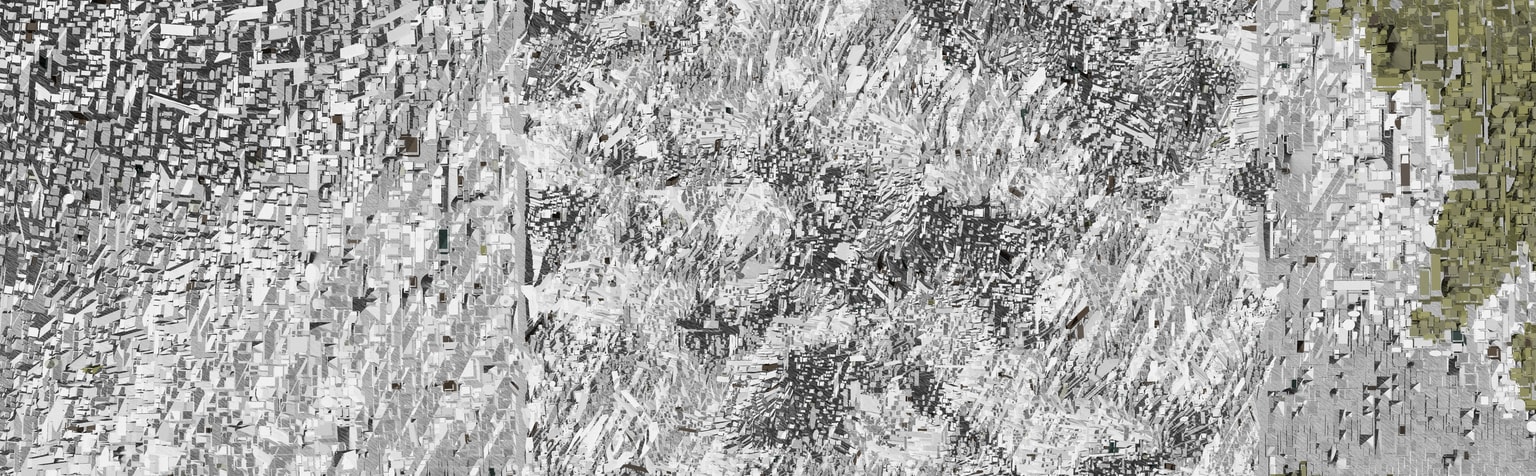
Pseudo-Landscape is an exploration of the relationship between natural landscapes and their artificial counterparts, such as architecture and urbanism.
Although these two domains are often seen as distinct, they are deeply interconnected, and can affect each other in multiple ways. This interconnection raises questions: Where do we draw the line between what is natural and what is artificial?
The boundaries between nature and the built environment are not always clear. Similar patterns and principles can be observed at various scales, from the smallest details to the largest structures.
Through the use of generative art, this piece illustrates how even a slight change in a small set of variables can result in vastly different artificial landscapes. It invites us to consider how this concept may also apply to our physical world, where seemingly minor alterations can have significant consequences.
The use of long form generative art allows for a deeper exploration of this idea. It invites the viewer to consider the relationship between change and diversity in our environments, and the effect that each variable may have.
The experiment
Here are 1024 uncurated sample images that were generated using a batch script.
These images should provide a good preview of what to expect with the live script.
Happy exploration!
Technical notes
The general approach to create this project has been to use many generic or ambivalent features. Some of them may be associated with one domain or the other, and combining different features may result in an abstract landscape with elements of both nature and man-made structures.
One challenge was to find a good balance for the box packing algorithm in terms of flexibility and speed. It originally started with a naive algorithm, but since the result drew more than 1'000'000 items I had to do some research in that direction.
After testing with different existing box packing algorithms or using different quadtree implementation I ended up with a custom solution loosely based on the quadtree logic. It takes the same "subgrid" approach, but without any sublevel handling and it is fine tuned for this specific use case.
For the rendering, I also spent a lot of time tweaking the shaders and generative hatch and stripes textures. The shader is based on a cross-hatching experiment by Jaume Sanchez. The final result is notably distinct, using the view projection instead of the object projection, generated texture instead of images, and various tweaks to make the shader fit this experiment. This allowed me to enforce the original concept by giving a more natural, technical or artificial feeling by utilizing various textures.
Features
The project make use of a lot of small features. It has 50 features, a few of them are explained below.

Fog
It can be enabled or not, and may represent nature or the opposite.

Grid
The grid can be small or bigger, sometimes making it look more like a map or architecture sketch.

ColorFunction
It can be flat or based on the individual block height, which adds a artificial feeling. There is also different variations of stripes, which I associate with crop fields, soil layers, …

Boundary
Some items have a boundary defined to represent the limit assign to landscape or territories. It can influence different parameters, from color to element transforms.

Camera height
The camera can have different height. Top camera can make the result look like a map. Lower ones can have different feels, from technical architecture mood to something more sculptural.


Texture
The result can use a subtle or a bit stronger texture. The stripe value can give a more technical feel, and finally there is also a hatch texture which is more natural but also can look like a technical sketch drawing.

Geometry
Items can have various shapes, from the the abstract cube, to more natural cylinder. Some geometries can also be distorted to make them more natural.

Displace
Individual blocks are generally placed on a rigid grid, but the displace feature can give a more organic feeling.
Palettes
There are two types of palettes, the manually defined ones, and also some generative palettes.
For each manual palettes there are two variants, and each artwork use colors inbetween these 2 variants to create more color diversity.
The generative palettes can use three different methods: complementaryDuotone, analogousDuotone and a triad function.

About
As a kid, I was captivated by the world of 3D art so I went to an art school. However, during my studies, I discovered ActionScript, which introduced me to the world of generative art.
After finishing school I became a web developer but never lost my passion for experimenting with real-time generative art and 3D art in my free time.
A few years later, after having two children, I wanted to dive deeper with my 2 passions, and started to try to merge generative art and traditional 3D workflow.
As a result of my experimentation, I began creating abstract landscapes and cities, which naturally led to exploring the contrast and conflicts between nature and artificiality. This subject matter became the central focus of my work.
Pseudo-Landscape is a deeper exploration of the complex relationship between humanity and the environment.
You can find more of my previous artworks here:


References
The initial concept for the work was to illustrate the relationship between nature and the industrial world, but it was also influenced by various other sources.
For instance, the emphasis on strong and changing patterns is inspired by the art of M.C. Escher. Additionally, some of the more spacious compositions may evoke images of the melting arctic sea or the rising sea levels.
Overall, the work aims to explore the connections and conflicts between the natural world and the impact of human industry.


